Home Solar · West Bengal
Does Rooftop Solar Work for Homes in Darjeeling and Kalimpong Hills? (2026 Guide)
Does rooftop solar work in the Darjeeling and Kalimpong hills? See how cold, fog and slopes affect output, and how to claim up to ₹78,000 subsidy.
The short answer
Yes, rooftop solar works for homes in the Darjeeling and Kalimpong hills. Cold air helps solar panels work better, but fog, mist and monsoon clouds lower output on some days, so the system must be sized on yearly output. Hill homes on a WBSEDCL connection can claim the PM Surya Ghar subsidy of up to ₹78,000.
Does rooftop solar really work in the Darjeeling hills?
Yes. Solar panels make power from daylight, not heat, so they work in the cool hill climate of Darjeeling, Kurseong, Mirik and Kalimpong. In fact, solar cells work best at low temperatures. When panels get hot, their voltage drops and output falls [2]. Most crystalline silicon panels used in India lose about 0.3% to 0.5% of their output for every degree Celsius above 25°C [1]. On a clear, cool winter morning in the hills, panels stay cooler than they would on a hot roof in the plains, which helps them. The real limit in the hills is not cold. It is cloud, fog and mist, which reduce the sunlight that reaches the panels.
How much do fog, mist and monsoon clouds reduce solar output?
Fog and haze cut the amount of sunlight reaching the panels. In bad winter smog in North India, sunlight can drop by 30% to 50% during peak months [1]. Hill fog is different from city smog, and it changes from valley to ridge, so no single number fits every home in Darjeeling or Kalimpong. What matters is this: a solar system is designed on its total output over a full year, and seasonal ups and downs are normal [1]. Clear months after the monsoon and in early spring make up for misty months. This is why a proper site survey that looks at your exact roof, slope and direction is more useful than a general estimate.
Which roofs in the hills are suitable for solar panels?
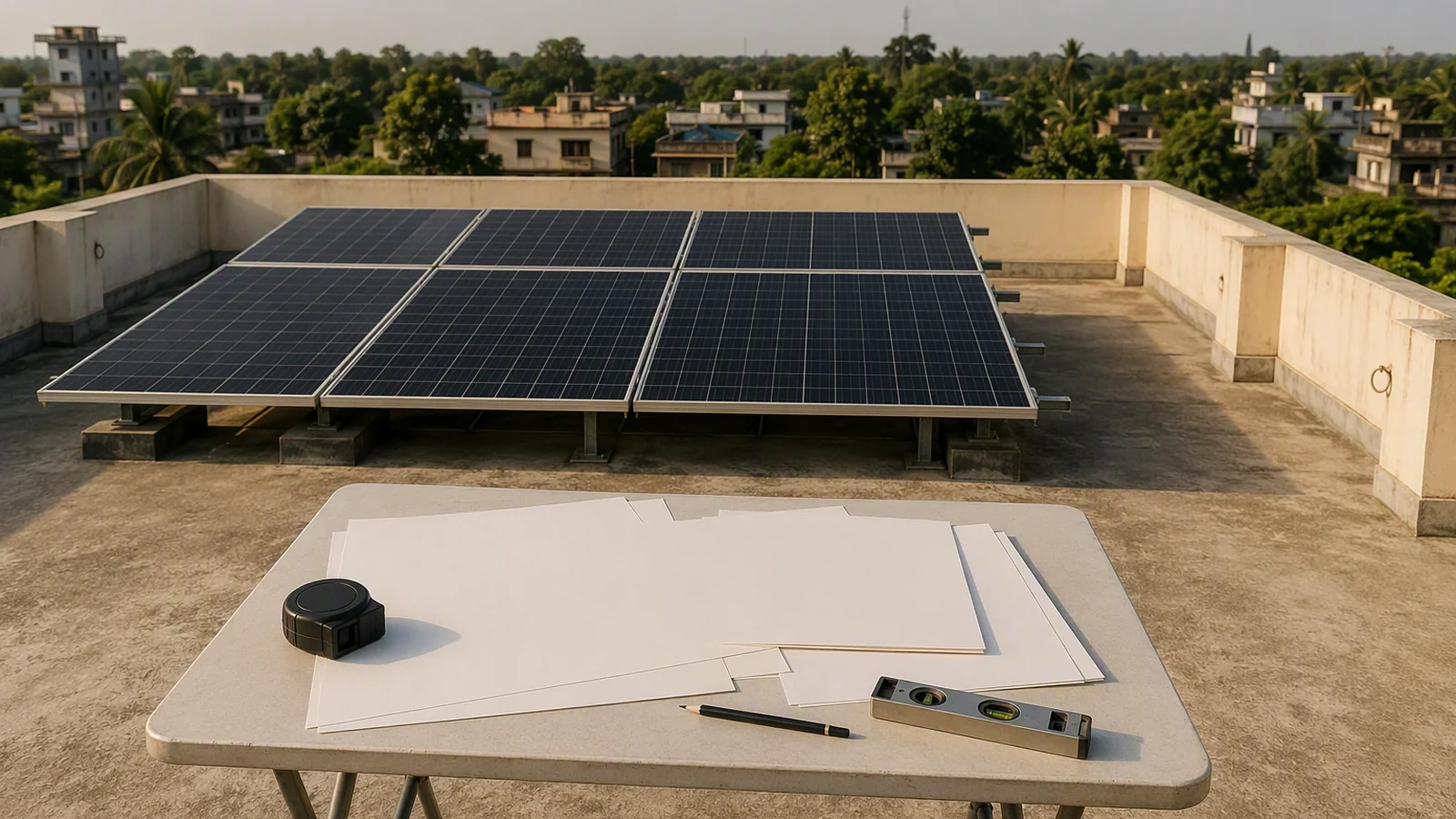
Hill homes have many roof types: flat RCC (concrete) roofs, sloped GI or tin sheet roofs, and roofs on homes built on steep slopes. All three can take solar panels if the structure is strong and the mounting is done correctly. Things to check on a hill roof are: (1) shade from tall trees, nearby buildings or the hillside itself, especially in the morning and evening; (2) which direction the roof faces, since a south-facing slope usually gets the most sun; (3) strong wind on ridges, so the mounting structure must be firmly fixed and rust-proof; (4) water leakage, since sheet roofs need proper sealing at every fixing point; and (5) safe access for cleaning, because moss, leaves and dust can build up in damp weather. Brijstar checks all of these during the site survey before suggesting any design.
Can homes in Darjeeling and Kalimpong get the PM Surya Ghar subsidy?
Yes, if the home has a domestic WBSEDCL electricity connection in West Bengal. The central subsidy is ₹30,000 for 1 kW, ₹60,000 for 2 kW and ₹78,000 for 3 kW or more, and it does not increase after 3 kW [3]. West Bengal does not give any extra state subsidy on top of this. The subsidy is not a discount. You pay for the system first, and the Government sends the subsidy to your bank account after the system is installed, inspected and approved on the portal [6]. If you take a solar loan, it can go to your loan account. The panels must be Indian-made DCR modules (DCR means Domestic Content Requirement, so both the cells and panels are made in India). Collateral-free loans for homes up to 3 kW are offered at around 7% interest under the scheme [3].
Is there any news this month that hill homes should know?
Yes. On 3 November 2026, the Union Minister for New and Renewable Energy said India is now completing about one lakh rooftop solar installations every six days. As of 2 November, the scheme had over 88.3 lakh applications and more than 55.3 lakh systems installed, with a target of one crore homes by 31 March 2027 [4]. The same week, an MNRE official said a second phase of PM Surya Ghar may begin around March 2027, and that MNRE is talking to insurance companies about special insurance for home rooftop systems [5]. No subsidy amounts or rules for the second phase have been announced yet [5]. So the current scheme, with its known subsidy, is the clear option today. As the deadline gets close, vendors, DCR panels and WBSEDCL inspections across the country may get busier, so starting early gives you more time to fix any problem.
On-grid or hybrid: which is better for hill homes?
An on-grid system is connected to the WBSEDCL grid with a net meter. It is simpler and is the type covered by the PM Surya Ghar subsidy. Its limit is that it switches off during a power cut for safety. A hybrid system adds a battery, so some lights and appliances keep running during power cuts, which can be useful in hill areas where supply is disturbed during storms or landslides. A battery adds cost and needs space that stays dry and ventilated. The right choice depends on how often you face power cuts and what you need to run during them. Brijstar explains both options at the survey and helps you decide based on your actual bills and needs.
Why choose a local installer for a hill home, and how do I start?
Hill work needs more care than a plain rooftop job: material has to be carried up narrow roads, structures must handle wind and rain, and WBSEDCL feasibility, net metering and inspection must be followed up with the local office. After installation, you need someone nearby who can come for service. Brijstar Green Energy is based in Siliguri, is an authorised channel partner of Tata Power Solar, and is a registered vendor on the PM Surya Ghar national portal for the WBSEDCL area. Brijstar files the subsidy application for you, handles WBSEDCL net metering liaison, design, installation and commissioning, and provides after-sales service. Home solar loans can be arranged through partner banks SBI, PNB, Bank of Baroda, Canara Bank, Union Bank of India, Bank of India and Indian Bank, subject to bank approval. We serve homes in Darjeeling, Kalimpong, Kurseong, Mirik, Siliguri and the rest of North Bengal. Book a free site survey with Brijstar: call or WhatsApp +91 99324 08999, or visit brijstar.com.
Common questions
Do solar panels work in cold weather in Darjeeling?
Yes. Solar panels work better when they are cool. Cold weather does not stop them; heavy fog and cloud are what lower output on some days.
Will solar panels work during fog and monsoon?
They still produce some power, but less. The system is designed on total yearly output, so clear months balance out misty ones.
Can I put solar panels on a tin or GI sheet roof?
Yes, with a proper mounting structure and sealing at every fixing point. The roof strength must be checked first at the site survey.
Is the subsidy different for homes in the hills?
No. Homes in Darjeeling and Kalimpong with a WBSEDCL domestic connection get the same central subsidy: up to ₹78,000 for 3 kW or more. West Bengal gives no extra state subsidy.
Should I wait for PM Surya Ghar phase 2?
No details of phase 2 have been announced. The current scheme has a known subsidy and is set to end on 31 March 2027, so it is the clear option today.
Sources and checks
- [1] The Better India – Why Solar Panels Dip in Delhi's Fog but Work So Well in Ladakh's Cold Sun (19 Dec 2025)
- [2] U.S. Department of Energy – Solar Photovoltaic Performance and Efficiency Basics
- [3] PM India – Cabinet approves PM Surya Ghar Muft Bijli Yojana (29 Feb 2024)
- [4] Business Today – India may soon install 1 lakh rooftop solar systems every 4-5 days, says Pralhad Joshi (3 Nov 2026)
- [5] Energetica India – MNRE Plans Second Phase of PM Surya Ghar by March 2027 (3 Nov 2026)
- [6] Business Today – Claim up to ₹78,000 under PM Surya Ghar scheme (28 Jul 2026)
Confirm current utility and scheme rules before purchase.
General technical references are not West Bengal approval rules.
Your next step
Check your home solar fit