Commercial · West Bengal
Rooftop Solar for Cold Storage in North Bengal: Jalpaiguri, Malda and Dinajpur (2026 Guide)
Rooftop solar for cold storages in Jalpaiguri, Malda and Dinajpur: cut WBSEDCL bills, pick net metering or net billing, and plan before the ALMM deadline.
The short answer
Rooftop solar suits cold storages in North Bengal because compressors and fans draw power every day of the storage season. Solar cuts the per-unit energy charge on your WBSEDCL bill in daytime, while net metering lets daytime surplus offset night use. Size the plant to your contract demand and season-wise load.
Why are cold storage owners in North Bengal looking at rooftop solar?
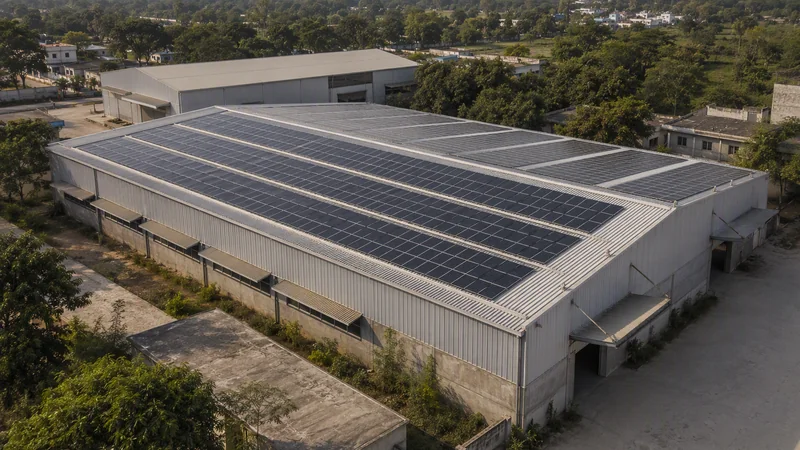
West Bengal's 2025-26 potato crop was estimated at over 140 lakh tonnes, the highest in five years, and cold storages loaded nearly 74 lakh tonnes this season, about 14% more than last season [2]. Industry officials said more than 95% of the state's cold storages were full [2]. More stock in the chambers means compressors, evaporator fans and lights work harder, and power is a major running cost for any cold storage. The roof is usually large, flat or gently sloped, and free of shade, which makes it a good place for solar panels. In October 2026, a 250 kW rooftop plant on a potato cold storage in Bankura district was reported as a working example in the state [1]. Owners in Jalpaiguri, Malda, Uttar and Dakshin Dinajpur, Cooch Behar and the rest of North Bengal can use the same idea on their own roofs.
How much can a cold storage save on its WBSEDCL bill?
WBSEDCL bills cold storages under their own tariff categories, separate from shops and offices. Its 2025-26 tariff gist shows an average tariff of about 675 paise (₹6.75) per unit for cold storage, and a special rebate of 25 paise per unit on the energy charge for low and medium voltage cold storages with a contract load of 50 kVA and above [3]. Solar reduces the energy charge, which is the per-unit part of the bill, for every unit it replaces. It does not remove the demand or fixed charge, which is linked to your contract demand, so the bill will not become zero. For the Bankura plant, the installer estimated yearly savings of about ₹28 lakh and a payback of 2 years and 8 months, on a site that used about 120 MWh a year before solar [1]. That is one site's estimate, not a promise for yours. The fair way to judge your own savings is to multiply the energy rate on your bill by the units your roof can produce in a year. A site survey gives you that number.
Solar works only in the day. What about night-time and off-season load?
A cold storage runs day and night, but panels make power only in daylight. Under net metering, the extra units your plant sends to the grid in the afternoon are set off against units you take from the grid at night [4]. This is why net metering suits a round-the-clock load. The bigger issue is the season. Load is high when the chambers are full and much lower when they are empty. Under WBSEDCL's procedure, surplus units carry forward within the financial year but reset to zero at the start of each new financial year [4]. So if the plant is too big for your empty months, some units can lapse. A good design looks at 12 months of your bills, not just the peak month, and sizes the plant so that the surplus from slow months gets used before 1 April.
Net metering or net billing: which is better for a cold storage?
Under the WBERC rooftop solar regulations of 2025 and WBSEDCL's procedure, the solar plant cannot be bigger than your contract demand or sanctioned load [4]. Net metering is allowed from 1 kW up to 500 kW, or up to your contract demand if that is lower. Net billing is allowed up to your contract demand [4]. In net billing, exported units are paid at a feed-in tariff, which for 2025-26 is ₹4.37 per unit for LT and MV, ₹3.89 for HV and ₹3.73 for EHV, while imported units are billed at your normal tariff [4]. Connections up to 170 kW (200 kVA) are LT; larger ones are HT at 11 kV and above [4]. For most cold storages that use most of their solar power on site, net metering is the simpler choice. Net billing can make sense if the plant is above 500 kW or if you expect a lot of export in the off-season. Your installer should show you both cases with your own bills.
Can a cold storage roof carry solar panels safely?
Many cold storage roofs are metal sheets over insulation, and the insulation is what keeps the chambers cold. Drilling carelessly through it can cause leaks and cold loss. In the Bankura project, roof weight limits were a challenge, and the team used a lighter Galvalume mounting structure to manage it [1]. Before any design, check the age and condition of the roof sheets, the strength of the purlins, the safe walking path for cleaning, and how the structure will be fixed without damaging the insulation. North Bengal also gets heavy monsoon rain and strong winds, so fixing and drainage need care. A proper survey covers all of this before a single panel goes up.
Should a cold storage add battery storage, and is there a deadline to watch?
A long power cut can put stored produce at risk, so many owners keep diesel generators. Battery storage (BESS) can give backup for critical loads during short cuts. The WBERC rules allow batteries with rooftop solar, but a battery-backed system must not send power into the grid during an outage [5]. Size the battery for what must keep running, not the full plant. There is also a panel rule to keep in mind. MNRE has said net-metering projects commissioned on or before 31 December 2026 are exempt from the ALMM List-II solar cell rule, and from 1 January 2027 such projects must use cells from List-II makers [6]. After that date the choice of approved panels gets narrower. If you want the wider choice, the plant has to be commissioned, not just ordered, by 31 December. Approval and meter fitting depend on WBSEDCL, so no installer can promise the date.
Why choose a local installer for a cold storage in North Bengal?
WBSEDCL's process has set steps: application on Form S1, a feasibility visit within 15 days, a go-ahead and meter quotation within 20 days, installation, Forms S5 and S6, inspection, then meter fitting and synchronisation [4]. The application fee is ₹1,000 for LT and MV and ₹5,000 for HV and EHV [4]. A local team can follow up at your supply office, visit quickly for faults, and keep the plant clean and working through the season. Brijstar Green Energy Pvt Ltd is a solar EPC company based in Siliguri, working for businesses across North Bengal, Sikkim and beyond. We do the site survey and load study, design, installation and commissioning, handle the WBSEDCL net metering or net billing paperwork, and give after-sales service. For commercial clients we offer leading brands, including Tata Power Solar, along with battery storage (BESS) and EV charging. Note that PM Surya Ghar subsidy is only for homes; cold storages and other businesses do not get it. To see what solar can do for your cold storage, book a free site survey with Brijstar: call or WhatsApp +91 99324 08999, or visit brijstar.com.
Common questions
Can a cold storage get the PM Surya Ghar subsidy?
No. PM Surya Ghar subsidy is only for individual homes. Cold storages and other businesses do not get it.
What is the largest solar plant a cold storage can install under WBSEDCL rules?
The plant cannot be bigger than your contract demand or sanctioned load. Net metering is allowed up to 500 kW; above that, net billing or gross metering can be used. [4]
Will solar run my cold storage at night?
Not directly. Panels work only in daylight. Under net metering, daytime surplus sent to the grid is set off against the units you use at night. [4]
What happens to extra units in the empty months?
Under net metering, surplus units carry forward within the financial year but reset to zero at the start of the next one. Under net billing, exported units are paid at the feed-in tariff. [4]
Will solar make my cold storage bill zero?
No. Solar cuts the per-unit energy charge for the units it replaces. Demand or fixed charges linked to your contract demand stay. [3]
Do I need to commission before 31 December 2026?
It is not compulsory, but net-metering projects commissioned by 31 December 2026 are exempt from the ALMM List-II cell rule, which applies from 1 January 2027. [6]
Sources and checks
- [1] Mercom India – West Bengal cold storage operator turns to solar to reduce power bills (1 Oct 2026)
- [2] Agro & Food Processing – Bengal potato output crosses 140 lakh tonnes; cold storage loading jumps 14% (16 May 2026)
- [3] WBSEDCL – Gist of Tariff Order for 2025-26
- [4] WBSEDCL – Procedures-C (2025): net metering / net billing guidelines and process
- [5] Construction World – WBERC issues new rules for rooftop solar prosumers (19 Aug 2025)
- [6] PV Tech – MNRE extends ALMM List-II exemption for net-metering and open access solar projects (20 Jul 2026)
Confirm current utility and scheme rules before purchase.
Your next step
Check your business site