Commercial Solar · West Bengal
Rooftop Solar for Factories and Warehouses in Matigara and Bagdogra: 2026 Guide
Planning rooftop solar for a factory or warehouse in Matigara or Bagdogra? Learn the WBERC rules, WBSEDCL steps, roof checks and tax points for 2026.
The short answer
Yes, factories and warehouses in Matigara and Bagdogra can install grid-connected rooftop solar under the WBERC 2025 rooftop rules and choose net metering, net billing or gross metering. The plant must fit your sanctioned load, and systems above 10 kW need a WBSEDCL feasibility check. A site survey decides the right size, roof work and metering option.
Why are factories and warehouses in Matigara and Bagdogra looking at rooftop solar now?
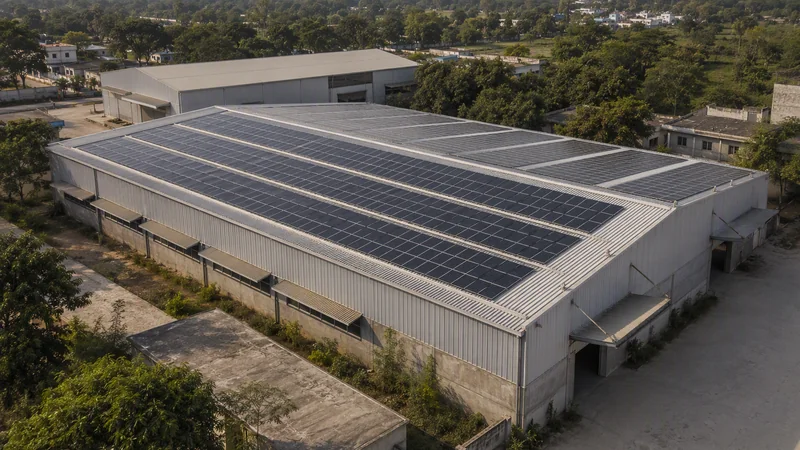
Matigara and Bagdogra, on the edge of Siliguri in North Bengal, have many small factories, godowns, logistics sheds and processing units. Most of them have large, flat or sloping metal roofs that stay empty all day, and most of their power use happens in daylight, which is exactly when solar produces. Industry reporting in 2026 notes that rising grid electricity tariffs are strengthening the economics of rooftop solar, even as module and equipment prices have moved up because of commodity costs and a weaker rupee [3]. For a business owner, this means two things: the saving from each unit of solar is getting more valuable, and it is worth locking in a design and quote early rather than waiting for prices to fall.
What do the WBERC 2025 rooftop solar rules mean for a business?
West Bengal's rooftop solar rules for prosumers (people who both use and produce power) were published in the Kolkata Gazette and became effective from 31 July 2025, and they apply across the state, including the WBSEDCL area [1]. Under these rules, a business can choose one of three metering options: net metering, net billing or gross metering [1][2]. Reports on the rules state that the solar capacity cannot be more than your sanctioned load or contract demand [2], and the total rooftop solar connected to a local feeder or transformer cannot exceed 100% of its capacity [1]. Battery storage can also be added to the system [2]. In simple words: the plant size is tied to your electricity connection, and the local grid must have room for it, so the WBSEDCL check is an important step.
Which metering option should a factory or warehouse choose?
In net metering, the power you export to the grid is set off against the power you import, using the meters installed by WBSEDCL. In net billing, the power you take from the grid is charged at the normal retail tariff, and the solar power you export is paid at a feed-in tariff fixed by WBERC. In gross metering, all your grid use is billed normally, and all solar generation is credited at the feed-in tariff [1]. The feed-in tariff for net billing and gross metering is valid for the 25-year life of the system [1]. A factory that runs mainly in daytime usually uses most of its solar on site, so the choice depends on how much you export, especially on Sundays and holidays. Brijstar compares your past 12 months of bills against each option before recommending one.
What is the step-by-step process with WBSEDCL?
First, Brijstar does a site survey: roof size and condition, shade, structure strength, your sanctioned load and your bills. Second, the application is filed with WBSEDCL, online or in hard copy [1], with a fee of ₹1,000 for low and medium voltage consumers and ₹5,000 for high and extra-high voltage consumers [1][2]. Third, systems up to 10 kW are treated as feasible automatically, while larger systems need a technical feasibility study by WBSEDCL [1][2]. Fourth, after approval, the plant is designed, installed and tested, with anti-islanding protection (a safety feature that switches the solar off when the grid fails) as required [1]. Finally, WBSEDCL installs the meters and the plant is connected. If new grid infrastructure is needed to connect your plant, the cost may fall on the consumer, so this should be checked at the survey stage [1].
What should you check on a factory or warehouse roof before installing solar?
Metal sheet roofs are common in Matigara and Bagdogra. Before solar goes up, check the age and condition of the sheets, as it is better to replace weak sheets first than to remove panels later. Check that the purlins (the steel members under the sheets) can carry the extra weight of panels and structures, and that the structure is designed for local wind and heavy monsoon rain. Leave walkways for cleaning and maintenance, keep panels clear of shade from water tanks, chimneys and nearby buildings, and plan safe cable routes away from stored goods. For warehouses with stock that can catch fire, proper DC cabling, earthing, lightning protection and fire-safe practices matter more than saving a little on material. Brijstar checks all of these in the free site survey.
Is there a tax benefit for business rooftop solar?
Businesses do not get PM Surya Ghar subsidy, which is only for homes. However, many businesses claim accelerated depreciation on solar plants. Published guides cite a 40% depreciation rate for solar in the first year under income tax rules, and only half of that rate if the plant is put to use for less than 180 days in the year it is bought [4]. This means the commissioning date can change your tax saving for the year. Tax rules can change and each business is different, so please confirm the exact benefit with your chartered accountant before deciding. For finance, businesses can also look at bank term loans, or at PPA and lease models where you pay for power instead of owning the plant.
Why choose a local installer like Brijstar for a commercial plant?
Brijstar Green Energy Pvt Ltd is a solar EPC company based in Siliguri, working for businesses across North Bengal, Sikkim and beyond. We handle the full job: site survey, design, WBSEDCL net metering liaison, installation, commissioning and after-sales service. We are an authorised channel partner of Tata Power Solar and also offer other leading brands for commercial clients, so the design can match your budget and roof. We also offer battery storage (BESS) and EV charging for businesses that want backup or are adding electric vehicles. Being close by means faster site visits and quicker service when you need it. To plan solar for your factory or warehouse in Matigara or Bagdogra, book a free site survey with Brijstar — call or WhatsApp +91 99324 08999, or visit brijstar.com.
Common questions
Can a factory in Matigara get the PM Surya Ghar subsidy?
No. PM Surya Ghar subsidy is only for individual homes. Businesses may instead look at tax benefits like accelerated depreciation; confirm with your CA.
How big a solar plant can my factory install?
Reports on the WBERC 2025 rules say the plant cannot be larger than your sanctioned load or contract demand. WBSEDCL also checks local grid capacity for systems above 10 kW.
What is the WBSEDCL application fee for rooftop solar?
₹1,000 for low and medium voltage consumers and ₹5,000 for high and extra-high voltage consumers, as per reports on the WBERC 2025 rules.
Can I add batteries to a factory solar plant?
Yes. The WBERC rules allow battery storage with rooftop solar. Brijstar offers battery storage (BESS) for businesses that need backup.
Will solar work on a metal sheet roof?
Yes, if the sheets and purlins are in good condition and strong enough. Weak sheets should be replaced before installation. A site survey confirms this.
Sources and checks
- [1] SolarQuarter – West Bengal issues new rules to boost rooftop solar for prosumers (from 31 July 2025)
- [2] Construction World – WBERC issues new rules for rooftop solar prosumers
- [3] Mercom India – Daily News Wrap-Up: Input costs, weak rupee strain solar economics (27 Aug 2026)
- [4] Heaven Green Energy – Solar accelerated depreciation: 40% vs 25% year-1 tax math (2026)
Confirm current utility and scheme rules before purchase.
Your next step
Check your business site