EV Charging · West Bengal
Solar EV Charging Stations for Hotels and Businesses in Gangtok, Sikkim: 2026 Guide
Plan a solar EV charging station for your hotel, petrol pump or shop in Gangtok. 2026 rules, PM E-DRIVE support, tariffs and steps, explained simply.
The short answer
Yes, a business in Gangtok can set up a solar-powered EV charging station. Setting up a charging station needs no licence under the Ministry of Power's 2024 guidelines. Rooftop or carport solar supplies daytime power, a battery can cover evenings, and the grid fills the gap. Start with a site survey to check roof space, load and parking layout.
Why are businesses in Gangtok looking at solar EV charging now?
Electric cars, taxis and two-wheelers are becoming more common, and tourists driving up from Siliguri and Bagdogra want to charge where they stay, eat or shop. The central government is also pushing public charging. Under the PM E-DRIVE scheme, ₹2,000 crore has been set aside for public EV charging stations, and as of 1 July 2026, ₹689 crore had been approved for 6,562 chargers through 3 oil marketing companies and 9 states [1]. The scheme runs up to 31 March 2028 [1]. For a hotel, homestay, restaurant, mall or petrol pump in Gangtok, a charger can bring in guests who stay longer. Pairing it with solar means more of the charging power comes from your own roof instead of the grid.
Do you need a licence to set up an EV charging station?
No. Under the Ministry of Power's Guidelines for Installation and Operation of EV Charging Infrastructure 2024, setting up and running an EV charging station is a de-licensed activity, so any business can do it [3][4]. You still need a proper electricity connection, and each charging station must have a separate meter [3]. Power utilities are expected to give these connections within set timelines of 3 to 90 days, depending on the area [4]. The guidelines also say charging stations can use solar energy in their operations [3]. In simple words: the rules allow it, but the electrical work, metering and safety must be done right, which is where an experienced EPC company helps.
How does solar help cut charging costs?
The 2024 guidelines say the electricity tariff for EV charging stations should not be more than the average cost of supply, with a lower rate during solar hours (9 am to 4 pm) and a higher rate outside them — 0.7 times the average cost of supply during solar hours and 1.3 times during non-solar hours [3][4]. Your own rooftop or carport solar produces power during those same daytime hours, so you use less grid power then. For evening charging, when grid power costs more, a battery energy storage system (BESS) can store extra solar power from the day. The exact tariff you pay depends on your local electricity supplier and state regulator, so check your own bill category before you plan.
Can a private business get PM E-DRIVE support for chargers?
Possibly, but do not count on it. Under the PM E-DRIVE charging guidelines, support levels depend on the type of location. Government offices, hospitals and educational institutions with free public access can get up to 100% support, while transport hubs, oil company fuel outlets and toll plazas can get 80% of upstream infrastructure and 70% of charger cost [2]. Shopping malls, markets and roadside facilities on highways and expressways can get 80% on upstream infrastructure only [2]. Proposals are sent by government agencies through nodal bodies and a dedicated portal, with BHEL as the implementing agency [2]. A private hotel or shop should plan the project so it makes sense even without this support.
What does a solar EV charging setup include?
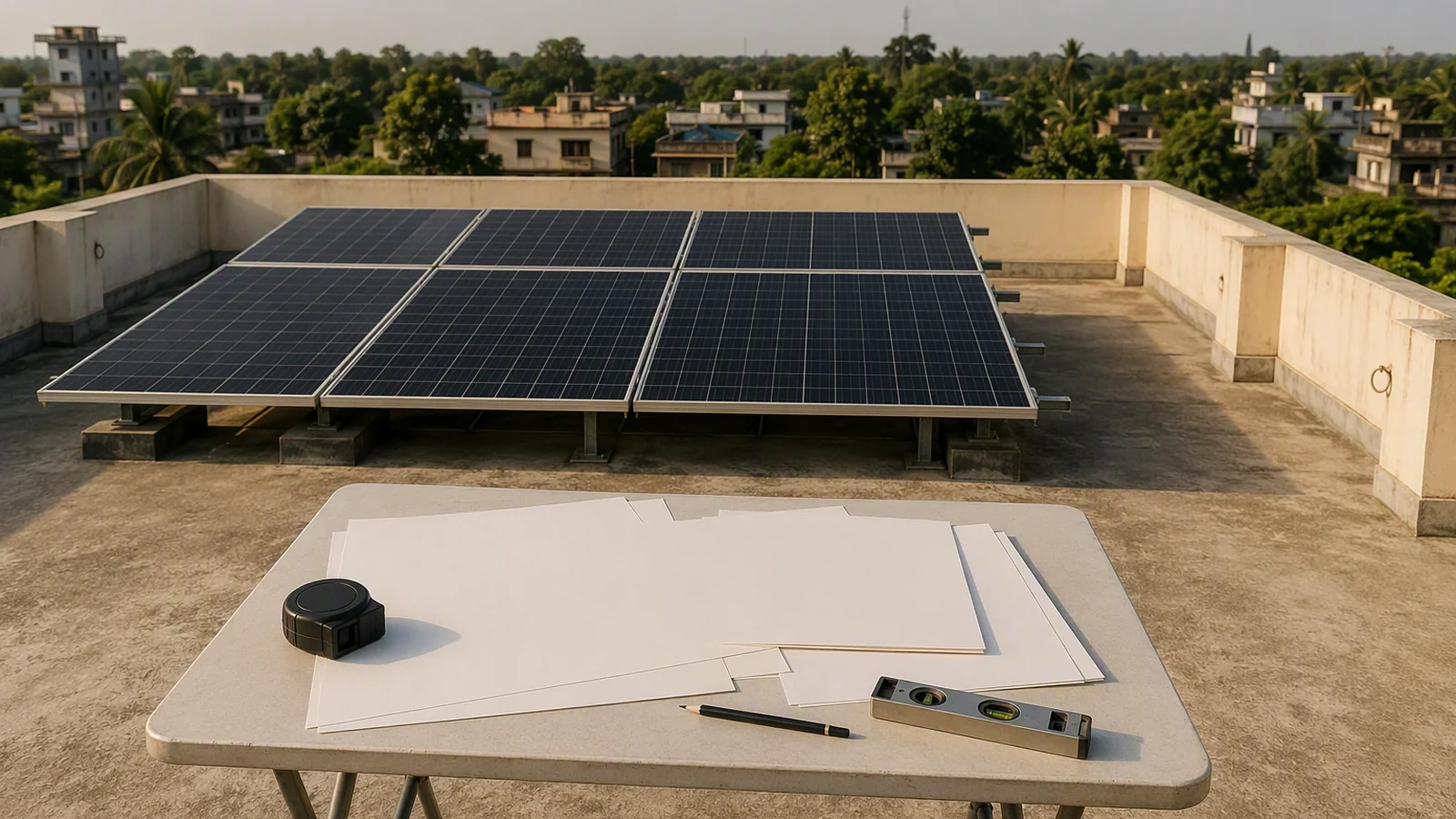
A typical setup has four parts. First, solar panels on the roof or on a carport over the parking area. Second, an inverter that turns solar power into usable AC power. Third, one or more chargers — slow AC chargers for guests who park overnight, or fast DC chargers for quick top-ups. Fourth, an optional battery for evening use. It also needs a separate meter, proper earthing, surge protection and cable sizing done to standard. In Gangtok, the design must also account for steep sites, limited parking, heavy monsoon rain and wind. A local survey checks shade from hills and nearby buildings, roof strength and how cars will enter and leave the charging bay.
How do you plan the project step by step?
Step 1: Decide who will charge — hotel guests, taxi fleets, staff or the public. Step 2: Check your current electricity connection and spare load. Step 3: Get a site survey for solar space, shade and parking. Step 4: Choose charger type and number. Step 5: Decide whether a battery is worth it for your evening demand. Step 6: Apply for the separate meter and any load increase with your electricity supplier. Step 7: Install, test and commission. Step 8: Set up regular cleaning and maintenance. Brijstar can handle design, installation, commissioning and after-sales service for solar, battery storage and EV charging, and offers leading brands, including Tata Power Solar, for commercial projects.
Why choose a local EPC company for this?
EV charging and solar touch your main electricity supply, so mistakes can be costly. A local team can visit your site quickly, understand hill conditions, and return for service when something needs attention. Brijstar Green Energy is a solar EPC company based in Siliguri that works for businesses across North Bengal, Sikkim and beyond, and offers solar, BESS and EV charging for commercial clients. If you run a hotel, homestay, restaurant, petrol pump, showroom or office in Gangtok or anywhere in Sikkim, book a free site survey with Brijstar — call or WhatsApp +91 99324 08999, or visit brijstar.com.
Common questions
Do I need a licence to open an EV charging station in Gangtok?
No. The Ministry of Power's 2024 guidelines make setting up and running a charging station a de-licensed activity. You still need a proper electricity connection with a separate meter.
Can solar alone run an EV charger?
Solar can supply power during the day. For evening or night charging you need grid power or a battery that stores daytime solar power.
Is there a subsidy for private EV chargers in Sikkim?
PM E-DRIVE support goes through government agencies and nodal bodies, and the level depends on location type. A private business should not assume it will get it. Plan the project to work without it.
Which charger is better for a hotel — AC or DC?
Slow AC chargers suit guests who park overnight. Fast DC chargers suit highway stops and taxi fleets that need quick top-ups. A site survey helps decide the right mix.
Do businesses get PM Surya Ghar subsidy for solar?
No. PM Surya Ghar subsidy is only for homes. Businesses do not get it.
Sources and checks
- [1] PIB – PM E-DRIVE Scheme and Promotion of Electric Mobility (28 Jul 2026)
- [2] All India Radio News – Guidelines for rollout of 72,300 EV charging stations under PM E-DRIVE
- [3] Mercom India – Ministry of Power releases EV charging infrastructure guidelines
- [4] Powerline – Ministry of Power releases EV Charging Infrastructure Guidelines 2024
Confirm current utility and scheme rules before purchase.
Your next step
Check your business site