Commercial Solar · West Bengal
Rooftop Solar for Hospitals and Nursing Homes in Siliguri: 2026 Guide
Rooftop solar for hospitals, nursing homes and clinics in Siliguri: cut daytime power bills, back up critical loads and follow WBSEDCL 2025 rules.
The short answer
Yes, rooftop solar suits hospitals and nursing homes in Siliguri because their heavy daytime load (AC, labs, lifts, pumps) matches solar hours. Under WBERC's 2025 rules, a WBSEDCL consumer can connect up to 500 kW or its sanctioned load, whichever is lower. Add a battery (hybrid system) if critical rooms need solar power during power cuts.
Why should hospitals and nursing homes in Siliguri consider rooftop solar?
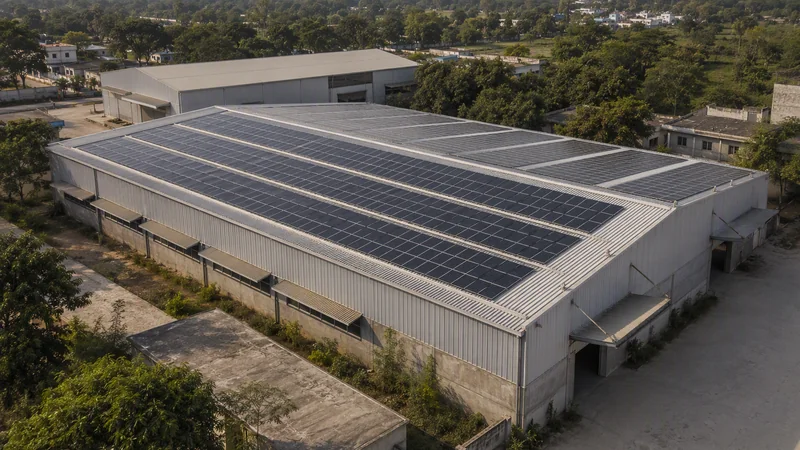
A hospital never switches off. Air conditioning, operation theatres, ICUs, labs, X-ray rooms, lifts, water pumps and laundry all run through the day, and most of this load is highest between 9 am and 5 pm. That is exactly when rooftop solar produces power. Every unit the panels make during the day is a unit the hospital does not buy from WBSEDCL. For a nursing home or multi-speciality hospital in Siliguri, Matigara or Bagdogra, this can bring the monthly electricity bill down and make running costs more predictable. Solar panels also have no fuel cost and very little running cost, so savings continue for many years after the system pays back. The exact saving depends on your tariff, your daytime load and your roof size, which is why a site survey and a study of your last 12 months of bills should come first.
Can solar keep the OT, ICU and lab running during a power cut?
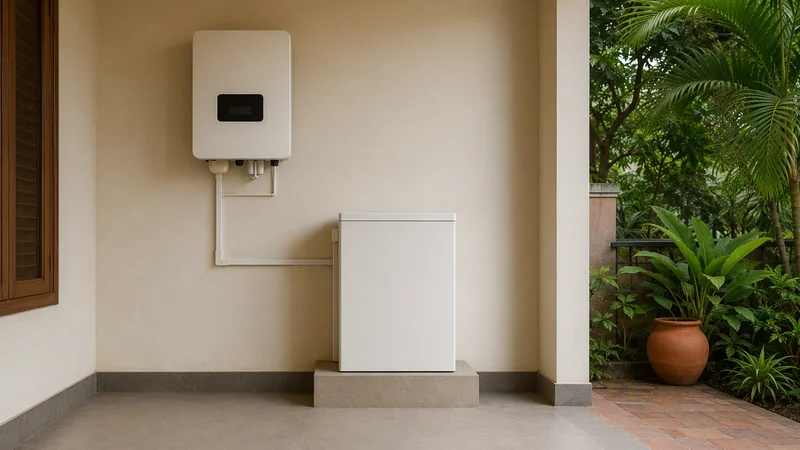
A normal on-grid solar system cannot. When grid power goes, the inverter must switch off. This is called anti-islanding, and it is a safety rule so that no power flows into the line while linemen are working on it [1][2]. So if backup is the main need, a hospital should choose a hybrid system: solar panels plus a battery bank (also called BESS, battery energy storage system) that feeds selected critical loads such as the OT, ICU, emergency lights, nurse stations and lab fridges. Even in a hybrid system, the battery is not allowed to send power back into the grid during a blackout [2]. Solar and batteries do not replace the diesel generator or UPS that hospital safety norms expect. Instead, they cut the hours the generator runs and the diesel it burns. Brijstar designs the backup part based on which rooms truly cannot lose power, so you do not pay for a battery bigger than you need.
What do WBSEDCL and WBERC rules allow for a hospital in 2026?
Rooftop solar in West Bengal now follows the WBERC (Grid Interactive Rooftop Solar Photovoltaic System for Prosumers) Regulations, 2025 [1]. Key points for a hospital: you need a sanctioned load of at least 1 kW; the system can be up to 500 kW or your sanctioned load or contract demand, whichever is lower [1][2]. You can choose net metering (exported units are set off against imported units), net billing (exported units earn a feed-in tariff fixed by WBERC, imported units are billed at your normal tariff) or gross metering (all solar is sold to the DISCOM at the feed-in tariff and your use is billed separately) [1][3]. The application fee is ₹1,000 for low and medium voltage connections and ₹5,000 for high voltage connections [1]. For systems above 10 kW, WBSEDCL has to finish a technical feasibility study within 15 days, and the system should be installed within 180 days of approval, with a possible 90-day extension [1][2]. Under net metering, surplus units carry forward within the financial year and reset at year end, so size the system to your own use rather than to sell power [1][2].
How big a solar system does a hospital or nursing home need?
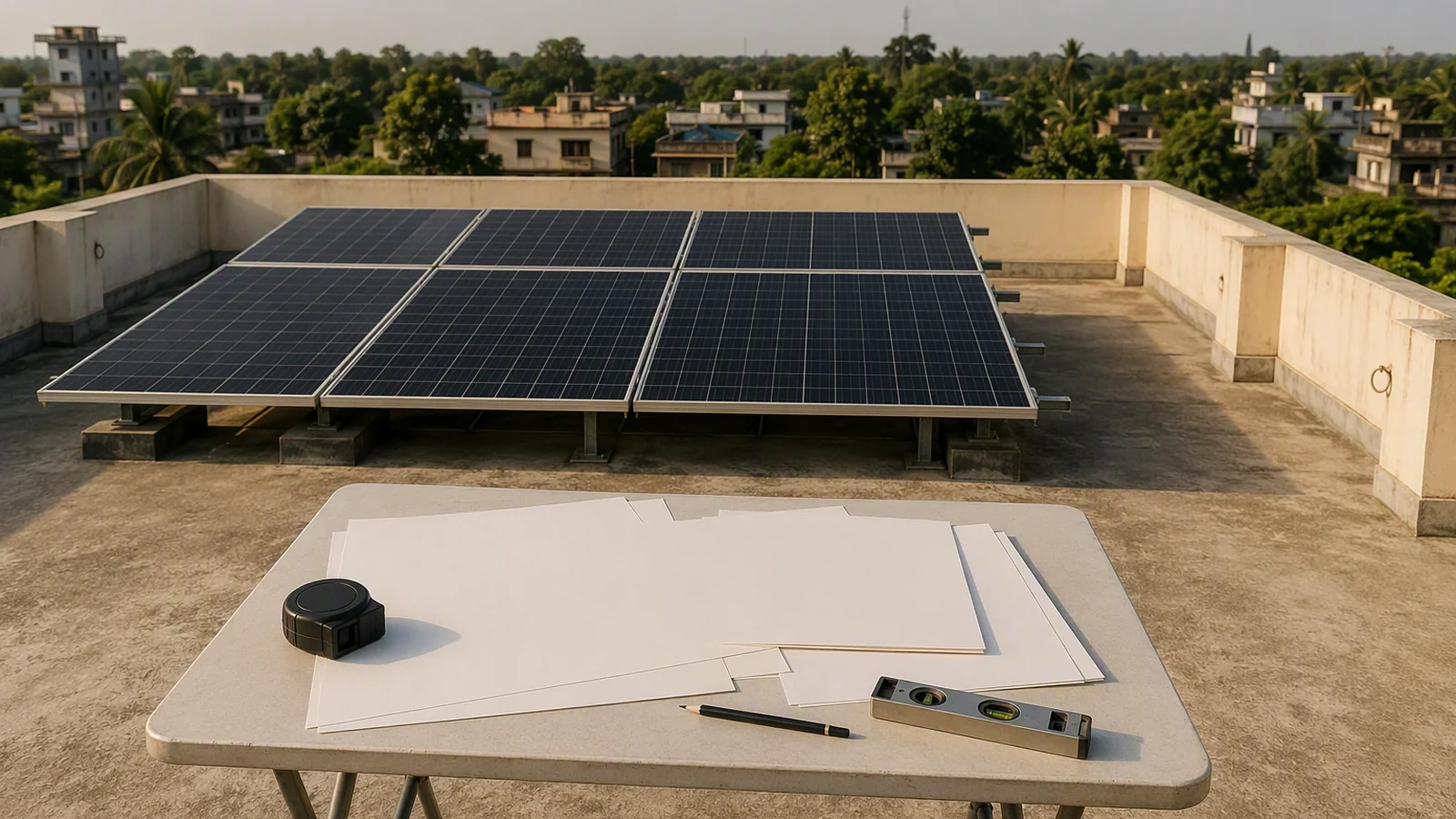
There is no single answer, and anyone quoting a size without seeing your bills and roof is guessing. Sizing is done in four steps. First, we study 12 months of WBSEDCL bills to see your units, contract demand and any seasonal peaks (summer AC load is usually much higher). Second, we look at when you use power, because a hospital with a big daytime load can use almost all its solar on site. Third, we measure the shadow-free roof area, keeping space for water tanks, lift rooms, AC units and fire exits. Fourth, we check the limit set by your sanctioned load and the 500 kW cap [1]. If backup is needed, we separately list the critical loads and the hours of backup required, and size the battery for those loads only. The result is a written design that shows expected generation, expected bill impact and payback, so the management can decide with real numbers.
What about roof safety, fire access and hygiene?
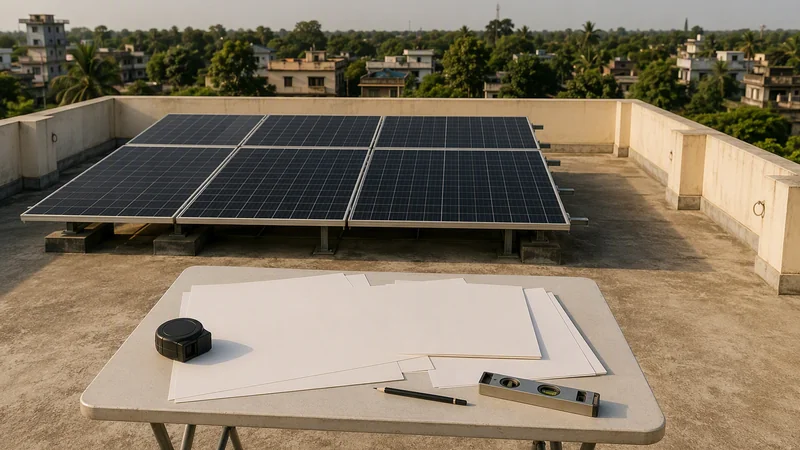
Hospital roofs need extra care. The structure must be checked so that the mounting frame does not overload the slab or cause leaks; we prefer methods that avoid drilling into the waterproofing. Walkways must be left clear for fire safety and for cleaning. DC and AC cables should be routed in proper trays and conduits, away from patient areas and oxygen lines, with correct earthing and lightning protection. North Bengal gets very heavy monsoon rain and strong winds, so frames, clamps and drainage must be designed for that. Panels need regular cleaning because dust and leaf litter reduce output, and the cleaning plan should not disturb hospital routines. Inverters and batteries should sit in a ventilated, locked area that hospital staff can reach easily but patients and visitors cannot.
How can a hospital pay for rooftop solar?
Hospitals and nursing homes are businesses under the electricity rules, so they do not get the PM Surya Ghar home subsidy. There are three common ways to pay. The first is to buy the system outright from your own funds, which gives the highest long-term saving. The second is a business loan or equipment loan from a bank such as SBI, ICICI Bank, Axis Bank or SIDBI, subject to the bank's approval, so the monthly saving on the power bill helps pay the EMI. The third is a PPA or lease (also called RESCO model), where an investor owns the plant on your roof and you pay only for the units you use; the 2025 WBERC rules allow RESCO-type models [2]. Each option has different costs, tax effects and contract terms, so speak with your chartered accountant before you choose. Brijstar can share the design and generation figures your bank or CA needs.
Why choose a local solar installer in Siliguri for a hospital project?
A hospital cannot wait days for a service visit. Brijstar Green Energy is based in Siliguri and works for businesses across North Bengal, Sikkim and beyond, so our team can reach your site quickly for surveys, faults and regular maintenance. We handle the full job: site survey, load study, design, WBSEDCL net metering or net billing application and follow-up, installation, commissioning and after-sales service. Brijstar is an authorised channel partner of Tata Power Solar and also offers other leading brands for commercial clients, along with battery storage (BESS) and EV charging for staff and visitor parking. If you run a hospital, nursing home, diagnostic centre or clinic in Siliguri, Jalpaiguri, Bagdogra or nearby, book a free site survey with Brijstar: call or WhatsApp +91 99324 08999, or visit brijstar.com.
Common questions
Will rooftop solar work during a power cut in my nursing home?
Only if you install a hybrid system with batteries. A plain on-grid system shuts down when grid power fails, as required by safety rules.
Can solar replace the hospital diesel generator?
No. Keep your DG set and UPS as required. Solar and batteries reduce how often the generator runs and how much diesel it uses.
What is the maximum rooftop solar size allowed for a hospital on WBSEDCL supply?
Up to 500 kW or your sanctioned load or contract demand, whichever is lower, under the WBERC 2025 rooftop solar regulations.
Do private hospitals get PM Surya Ghar subsidy?
No. PM Surya Ghar subsidy is only for homes and eligible housing societies. Hospitals and nursing homes are treated as businesses.
How much is the WBSEDCL application fee for rooftop solar?
₹1,000 for low and medium voltage connections and ₹5,000 for high voltage connections, as per the 2025 WBERC regulations.
How long does approval take for a hospital solar plant?
For systems above 10 kW, WBSEDCL must complete the technical feasibility study within 15 days. Overall time depends on documents and site work, so no fixed date can be promised.
Sources and checks
- [1] Energetica India – WBERC issues Grid-Interactive Rooftop Solar PV Regulations, 2025
- [2] Lawrbit – WBERC Rooftop Solar Regulations 2025 explained
- [3] Mercom India – WBERC sets net billing and gross metering feed-in tariffs for rooftop solar
Confirm current utility and scheme rules before purchase.
Your next step
Check your business site