Commercial Solar · West Bengal
Rooftop Solar for Schools and Colleges in Jalpaiguri and Cooch Behar: 2026 Guide
Rooftop solar for schools and colleges in Jalpaiguri and Cooch Behar: cut daytime power bills, handle holidays smartly and follow WBSEDCL 2025 rules.
The short answer
Yes. Rooftop solar suits schools and colleges in Jalpaiguri and Cooch Behar because classes, labs, computers, fans and lights run in the daytime, when panels produce power. Under WBERC's 2025 rules, a WBSEDCL consumer can install up to 500 kW or its sanctioned load, whichever is lower. Schools do not get PM Surya Ghar subsidy.
Why is rooftop solar a good fit for schools and colleges in Jalpaiguri?
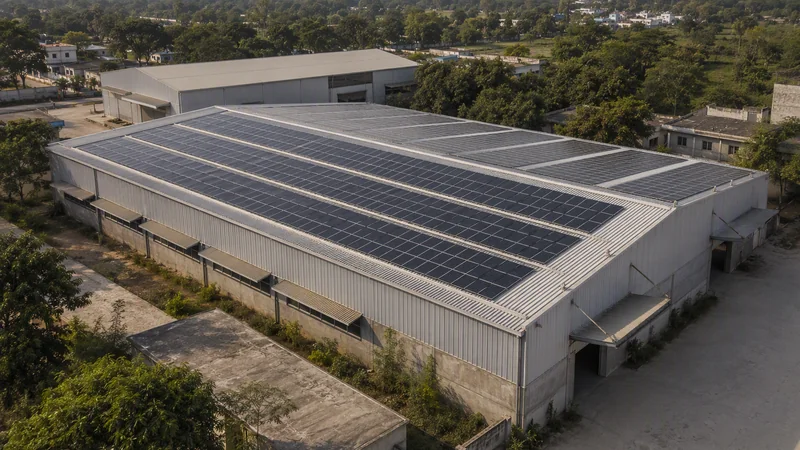
A school uses most of its power between 8 am and 4 pm. Fans, lights, smart classrooms, computer labs, science labs, water pumps, offices and hostels all run while the sun is up. Rooftop solar produces power at exactly these hours, so almost every unit the panels make is used inside the campus instead of being bought from WBSEDCL. This is why commercial and institutional rooftop systems are usually sized to daytime load and use most of their output on site [5]. Schools and colleges also have something many businesses lack: large flat roofs on classroom blocks, halls and hostels. In Jalpaiguri, Cooch Behar and other North Bengal towns, many school buildings have open terraces with little shade, which is ideal for panels. Rooftop solar is growing fast across India; grid-connected rooftop capacity reached about 34.97 GW by the end of October 2026 [4]. Schools elsewhere are already using it: in Andhra Pradesh, 3.5 MW was installed across 415 government schools, with bill cuts of about 55% expected [3]. Your saving will depend on your own bills, load and roof, which a site survey will show.
What happens to solar power during summer and Puja holidays?
This is the most common question from school managements. During vacations the campus uses very little power, but the panels keep producing. With net metering, the extra units go to the WBSEDCL grid and are set off against the units you buy later, for example on cloudy monsoon days or in the evenings. Under the WBERC 2025 rules, surplus credits carry forward within the financial year, but any balance left at the end of the year resets to zero [1][2]. So a school should not build a system much bigger than its yearly use, because extra units at year end are lost. A good design looks at 12 months of bills, counts holiday months and exam months, and sizes the system so that almost all solar units are used or set off within the same year. Hostels, staff quarters and boarding blocks that run all year help balance the holiday dip.
What do WBSEDCL and WBERC rules allow for a school in 2026?
Rooftop solar in West Bengal follows the WBERC Grid Interactive Rooftop Solar PV Regulations, 2025 [1]. The main points for a school or college are simple. You need a sanctioned load of at least 1 kW, and the system can be up to 500 kW or your sanctioned load or contract demand, whichever is lower [1][2]. You can choose net metering (exported units are set off against imported units), net billing (exported units are paid at a feed-in tariff set by WBERC) or gross metering (all solar is sold to the DISCOM and your use is billed separately) [1]. The application fee is ₹1,000 for low and medium voltage connections and ₹5,000 for high voltage connections [1]. Systems up to 10 kW are treated as technically feasible without a study; for larger systems, WBSEDCL must finish the feasibility study within 15 days, and the system should be installed within 180 days of approval [1][2]. The inverter must switch off during a grid failure (anti-islanding) for linemen's safety [1][2].
Why should schools plan their solar project before 31 December 2026?
Solar modules for net metering projects must follow MNRE's ALMM rules (Approved List of Models and Manufacturers). ALMM List-II, which covers solar cells, has a relief window for net metering and open access projects that runs till 31 December 2026 [4]. After this, the rules on which cells can be used get stricter, and this may affect equipment choice, availability and project timelines [4]. This does not mean a school must rush or that prices will surely rise. It means that a school which has already decided to go solar should start the survey, design and WBSEDCL application early, so the project is not caught between rule changes. Your installer should confirm the latest ALMM status for the exact modules in your quotation.
Do schools and colleges get a solar subsidy?
No. The PM Surya Ghar subsidy is only for homes and eligible housing societies, so private schools, colleges, coaching centres and hostels do not get it. Government schools are usually covered by their own department programmes, as in the Andhra Pradesh example where the school education department installed rooftop solar on government schools [3]. A private school can pay in three common ways. First, buy the system from its own funds, which gives the highest long-term saving. Second, take a business or equipment loan from a bank such as SBI, ICICI Bank, Axis Bank or SIDBI, subject to the bank's approval, so the monthly bill saving helps pay the EMI. Third, use a RESCO model (also called PPA), where an investor owns the plant on your roof and you pay only for the units you use; the 2025 WBERC rules allow this [2]. Talk to your chartered accountant before choosing, because trusts and societies have different tax positions.
What should a school check about roof safety and students?
Safety comes first on a campus. The roof structure must be checked so that the mounting frame does not overload the slab or cause leaks, and fixing methods should protect the waterproofing. The solar area should be fenced or locked so that students cannot reach panels, cables or inverters. DC and AC cables must run in proper trays and conduits, with correct earthing and lightning protection. Jalpaiguri and Cooch Behar get very heavy monsoon rain and strong winds, so frames and clamps must be designed for that. Leave walkways for cleaning and fire access. Panels need regular cleaning because dust and leaves cut output, and cleaning can be planned for weekends or holidays. A solar plant can also be a live science lesson: a simple display board showing daily generation helps students learn about clean energy.
Why choose a local solar installer for a school project in North Bengal?
A school needs an installer who will still be around for service visits, WBSEDCL meter issues and yearly checks. Brijstar Green Energy is based in Siliguri and works for businesses and institutions across North Bengal, Sikkim and beyond. We handle the full job: site survey, study of your last 12 months of bills, design, WBSEDCL net metering or net billing application and follow-up, installation, commissioning and after-sales service. Brijstar is an authorised channel partner of Tata Power Solar and also offers other leading brands for commercial clients, along with battery storage (BESS) for critical loads and EV charging for staff and school buses. If you manage a school, college, hostel or coaching centre in Jalpaiguri, Cooch Behar, Alipurduar or nearby, book a free site survey with Brijstar: call or WhatsApp +91 99324 08999, or visit brijstar.com.
Common questions
Can a private school in Jalpaiguri get PM Surya Ghar subsidy?
No. PM Surya Ghar subsidy is only for homes and eligible housing societies. Schools and colleges are not covered.
What happens to extra solar units during school holidays?
Under net metering, extra units go to the WBSEDCL grid and are set off against later use within the same financial year. Any balance left at year end resets to zero.
What is the maximum rooftop solar size a school can install on WBSEDCL supply?
Up to 500 kW or the school's sanctioned load or contract demand, whichever is lower, under the WBERC 2025 rooftop solar regulations.
Will a school's solar system work during a power cut?
A plain on-grid system switches off during a power cut for safety. You need a hybrid system with batteries to run selected loads during outages.
How much is the WBSEDCL application fee for school rooftop solar?
₹1,000 for low and medium voltage connections and ₹5,000 for high voltage connections.
Sources and checks
- [1] Energetica India – WBERC issues Grid-Interactive Rooftop Solar PV Regulations, 2025
- [2] Lawrbit – WBERC Rooftop Solar Regulations 2025 explained
- [3] Mercom India – Andhra Pradesh schools trim energy costs with rooftop solar (July 2026)
- [4] SolarQuarter – India's solar capacity crosses 174.5 GW as October additions reach 3.5 GW (12 Nov 2026)
- [5] Ember – Plugging storage into India's rooftop solar revolution (Oct 2026)
Confirm current utility and scheme rules before purchase.
Your next step
Check your business site